St. Michael’s, Ham

labyrinth/st.michaels.jpg

And then I was here.

After a busy term at school, a typically hectic end to it, a rush to pack and a flight back to the UK, a few magical days in Northumberland and a train journey down to London and across the city to Richmond, I was here, back at St. Michael’s Convent.

A number of years ago, my spiritual director had asked me where I went on retreat, and I had told him, sheepishly, that I didn’t. His reaction was straightforward; that won’t do. And he followed that up with two recommendations for places I could easily go. Since my brother lived in London at the time, I decided to come to St. Michael’s.

I remember arriving for the first time and feeling rather anxious, because I really didn’t know what I was supposed to do, and I was wondering how on earth I was going to spend the next three days. The sister who showed me around gave me all the information I needed then left me in my room. I knelt to pray and found myself crying, not knowing why or for what, but just letting it all come out.

That first year I attended some of the daily offices, but was quite new to the rhythm of the day and felt a little awkward. I spent time in the garden, reading Julian’s Revelations, and generally being quiet. At that time, almost all the meals were taken in silence, with only one supper a ‘talking meal’. It was the end of my second day and as I sat down one of the elderly sisters said to me, “Are you on retreat? Because we’re talking!”

The following year I was back, this time with a version of the Cloud of Unknowing and a bit more idea of what to do and how to use my time. I felt more comfortable attending the daily offices, and found that attending them all gave my day a focus and a rhythm that very quickly took me away from all the cares and concerns I had arrived carrying. More of the meals were ‘talking meals’ and one evening the sisters had a lively discussion about who would go to Compline and who would be able to go straight to the sisters’ private sitting room to watch Midsomer Murders.

I continued for several years, but in 2012 and again in 2013 I just couldn’t make the dates work and had a retreatless summer. Last year I went to Norwich and called it a retreat, but then spent a lot of time talking to people and felt irritated that I didn’t have the same feeling of peace and slowing down that I had after my visits here.

And so I decided I really needed to make the dates work somehow this year, and just managed to squeak in for a retreat before the house closes for the summer. I also arranged a visit to Norwich, but decided I needed to reframe that as a short pilgrimage, rather than a retreat.

So here I am. I arrived almost twelve hours ago, just in time for the midday Eucharist. I have once again come here with a copy of Julian, but this year I have the Mirabai Starr translation. I attended Evening Prayer and Compline, and while neither was the form I am used to, since I am more familiar with the Episcopal Church’s BCP daily offices, the form no longer has me stranded or caught in the headlights. I know I can find my way through and know what I’m doing.

This afternoon I spent some time in the garden and walked the small labyrinth. Not really knowing what to do, but having the space all myself, I took off my shoes and walked slowly, reciting one word of the Jesus Prayer for each step, then stopping to pray for whoever or whatever came to mind. I went slowly, gently, and found myself unpacking all the prayers that have been part of my daily intercessions, round and round, until I had prayed them all out. A squirrel sat in the grass only a few metres away and watched me intently. It was nice to have a little company in that green space.

I shall do it again tomorrow, and try to find a way to incorporate some kind of walking meditation into my prayer life in Tokyo, because it just felt so right to walk, and pray, and raise each person or concern up and let God take care of it.

I put my shoes back on and walked through the garden feeling reassured that I had given my concerns to God and that truly, all shall be well.

Evening Prayer, St. Michael’s

image

I usually go to church every Sunday morning and attend a service of Holy Eucharist, so it was a strange and somewhat unsettling feeling to not have my Sunday morning follow its usual pattern. Instead, I got up, had breakfast, then said Morning Prayer. After that I went sightseeing, specifically to places along Hadrian’s Wall.

While I felt a bit undone not to have received communion, I was reassured to find that the local church had a service of Evening Prayer at 6pm. I decided I would go there, not really knowing what I would find. I attend Evening Prayer in Tokyo, but I hadn’t attended a Church of England Evening Prayer in a very long time.

The church was quite large, and a 10-minute walk from the hotel, actually on the edge of the village of Wark. As I arrived, the organist was just arriving too, and gave me a lovely welcome. Once inside the church, she made sure I had the books I needed and also introduced me briefly to the church warden.

I sat down and realised I had a words-only version of Hymns Ancient and Modern, and the tiny black book of the 1662 Book of Common Prayer. Eek. Not my favourite thing. I found the section for Evening Prayer and when the priest walked past and stopped to say hello I checked I was on the right page.

Now, the interesting thing to me was, I was given a lovely welcome, but no help at all navigating the books and the service. That was all right, because I have attended other services enough that I know what I’m doing most of the time, but they didn’t know that.

The service was lovely, I found it more moving than I had expected, since I am not a fan of the 1662 prayer book, and wonder why people want to use the vernacular from half a millennium ago, but this evening it worked for me. Everything was done in a very simple and low-key way, and it was a beautiful way to end the day.

The bans were read for the 3rd time for a local couple, who were in the church to hear them read. Prayers were said for a recently-departed soul, and there were members of the congregation moved and upset, clearly close to the person mentioned in the prayers. During the intercessions at the end of the service, the priest walked to the centre of the church and knelt in the aisle to pray from among the people.

As I left I was thanked for coming, and I returned the gratitude. I was grateful to have been able to share in their worship. It felt like a very prayerful, intimate community of worshipers, and it was lovely to be welcomed into their midst for an hour. I was moved by their unfussy, gentle use of the 1662 prayer book, for showing me that it could be a wonderful way to worship. I left feeling at peace and glad to know that they are there, worshiping and praying, every week.

My eighth Julian

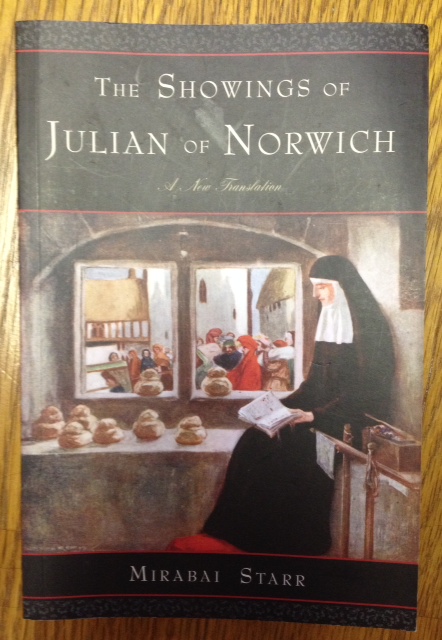
Mirabai Starr:Julian

And just like that, I found ‘my’ Julian. The translation which sounds to me like Julian’s authentic voice, the one that feels like home, the one that touches my heart: The Showings Of Julian Of Norwich, A New Translation by Mirabai Starr, published by Hampton Roads.

When I first started reading different editions aloud of Julian as part of my daily devotion I had 2 aims. One was to find the edition I could take to read from every day, and the other was to be able to give or recommend a full text to anyone who was looking for one.

So this is my eighth Julian, but only the sixth complete text. The first was the pocket-sized Enfolded In Love book, and I keep a stack of them at home to give as a taster of Julian’s writing. I have given the current Penguin Classic (Elizabeth Spearing translation) a couple of times, and the John Skinner translation, but while I really liked them I didn’t feel I had found a translation to live with.

There have been translations I had expected to love which have left me cold, and so I came to this one without many expectations. The biography of the translator at the back of the book describes her as being ‘at the vanguard of the emerging Interspiritual movement’ and I read it with a sinking feeling, anticipating some kind of New Age woolly version of Julian.

How wrong I was. One of the quotes on the back of the book describes it as a ‘faithful but freeing’ translation, and while I haven’t read Julian’s original version I agree that this version is wonderful. It flows, it is poetic, it is easy to read and read aloud has the easy, musical cadences of a woman speaking of things she has meditated upon and knows well, of things she loves deeply and wants to share. This, to me, is Julian’s voice.

I still have a number of translations to read, but I have found  a translation to live with, to return to again and again. A translation as good as this is a wonderful gift to the world; to achieve it required a sensitivity to the material, but also a humility, a willingness to step back, to remove the self from the equation and facilitate another’s communication. This is Julian’s voice, and only Julian’s voice, and this is what makes this book stand apart from all the others I have read. All the others, to some degree, for me had a feeling of control, of another voice or mind beside Julian’s.

Mirabai Starr has crafted a wonderful translation, she has given Julian her voice.